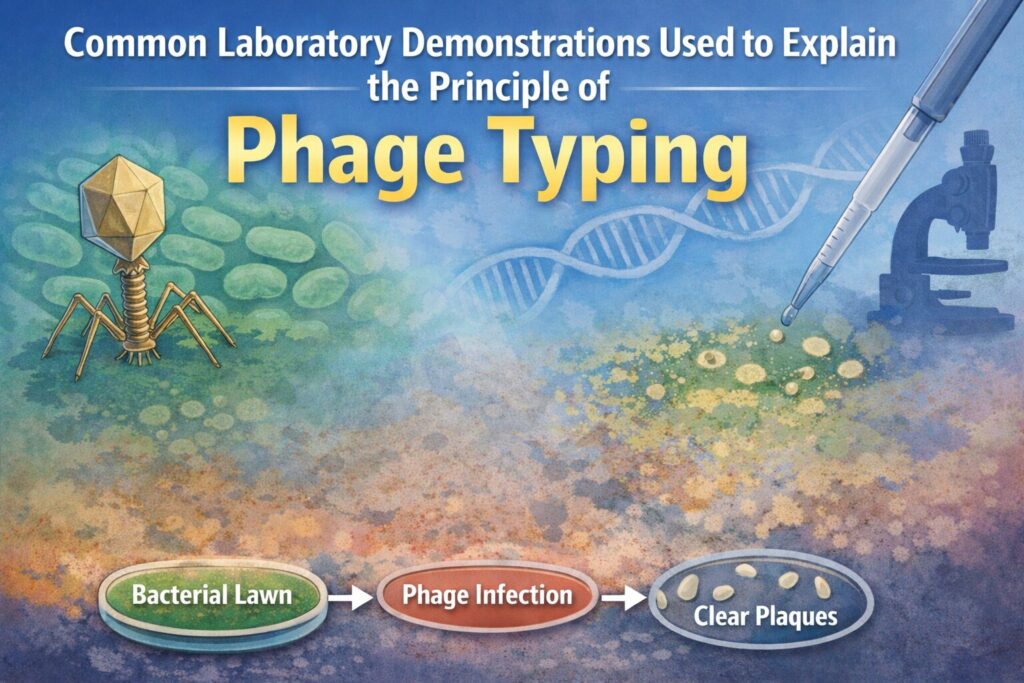
Introduction
Phage typing is a classic microbiological technique used to distinguish between closely related bacterial strains based on their susceptibility to specific bacteriophages. Although modern genomic tools have largely replaced phage typing in diagnostic laboratories, the method remains an essential teaching tool for understanding bacteriophage host specificity, plaque formation, and bacteria–virus interactions.
One of the most common teaching questions encountered in microbiology courses is:
“Describe how this exercise demonstrates the principle of phage typing.”
This article explains the principle of phage typing and describes how a simple laboratory demonstration—based on plaque patterns on bacterial lawns—effectively illustrates this concept. I decided to use an educational exercise published in the Journal of Microbiology & Biology Education (cited below) as a central example, showing how phage typing can be taught clearly and safely, even without live bacteriophages.
What is phage typing?
Phage typing is a phenotypic method used to differentiate bacterial strains by testing their susceptibility to a defined set of bacteriophages. Because bacteriophages are highly specific to their bacterial hosts, different strains of the same bacterial species often display distinct patterns of lysis when exposed to the same panel of phages.
The key principle underlying phage typing is host specificity:
- A phage can infect only bacteria that possess the appropriate surface receptors.
- If infection occurs, the phage replicates and lyses the bacterial cell.
- Lysis results in visible plaques—clear zones in an otherwise opaque bacterial lawn.
The combination of phages that successfully lyse a bacterial strain forms its phage type, which can be used for identification, comparison, or epidemiological tracking.
Plaque assays as the foundation of phage typing
A plaque assay is the laboratory technique that makes phage typing possible. In this assay:
- A uniform lawn of bacteria is grown on an agar plate.
- Phages are applied to the surface of the lawn.
- Where a phage successfully infects and lyses bacteria, a clear zone (plaque) appears.
- The absence of plaques indicates bacterial resistance to that phage.
Importantly, not all bacterial strains produce the same plaque patterns, even when exposed to identical phages. This variability is the biological basis of phage typing.
A common teaching demonstration of phage typing
A widely adopted teaching demonstration was described by Khan and Read (2018) in the Journal of Microbiology & Biology Education. The exercise was designed for undergraduate microbiology students to demonstrate plaque formation and phage typing principles in a single practical session.
Overview of the demonstration
- Students are provided with three agar plates, each representing a bacterial isolate from a different hypothetical hospital ward.
- Each plate contains a lawn of Staphylococcus aureus.
- Instead of live bacteriophages, a diluted laboratory disinfectant is used to create simulated plaques that visually resemble phage-induced lysis.
- Each plate displays a different pattern of clear zones, mimicking the outcome of real phage typing experiments.
Students are instructed to record which “phages” produce plaques and to compare patterns across the different isolates.
How this exercise demonstrates the principle of phage typing
Direct answer to the exam question
This exercise demonstrates the principle of phage typing by showing that different bacterial strains exhibit different susceptibility patterns when exposed to the same set of phages.
Explanation in practical terms
The principle is illustrated through several key observations:
- Each agar plate represents a different bacterial strain, even though the species is the same.
- Clear zones on the plate indicate susceptibility to a particular phage.
- Areas with no clearing indicate resistance to that phage.
- The combination of positive and negative reactions creates a unique lysis pattern for each strain.
For example, if plaques are observed at positions corresponding to phages 1, 5, and 7, the strain is recorded as phage type 1/5/7. A different strain exposed to the same phages may show plaques at entirely different positions, producing a different phage type.
Because the phage panel remains constant while the plaque patterns change, students clearly see that phage typing relies on host specificity rather than random killing.
Why simulated plaques are effective for teaching
Although the exercise uses disinfectant instead of live bacteriophages, it remains biologically accurate at the conceptual level:
- The visual outcome (zones of clearing) is identical to real plaques.
- The interpretation process mirrors that used in diagnostic phage typing.
- Students practice:
- Recognizing plaque patterns
- Recording phage types
- Comparing bacterial isolates
- Drawing conclusions about strain relatedness
This approach allows instructors to teach phage typing without the cost, biosafety concerns, or technical variability associated with maintaining live phage stocks.
Educational and clinical relevance of phage typing
Historically, phage typing played a major role in tracking hospital outbreaks of pathogens such as Staphylococcus aureus and Salmonella species. While whole-genome sequencing has largely replaced it in modern diagnostics, the method remains pedagogically important because it:
- Introduces the concept of biological specificity
- Demonstrates virus–host interactions
- Lays conceptual groundwork for modern applications such as:
- Phage therapy
- Host-range testing
- Virome ecology
Understanding phage typing also helps students appreciate why bacteriophages are being revisited as tools to combat antibiotic-resistant bacteria.
Conclusion
Common laboratory demonstrations using plaque patterns provide a clear and effective way to explain the principle of phage typing. By comparing zones of clearing on bacterial lawns exposed to the same phage panel, students observe that bacterial strains can be differentiated based on their susceptibility to specific phages. This exercise demonstrates that phage typing relies on host specificity and reproducible lysis patterns, making it a powerful teaching tool for understanding bacteriophage biology, even when simulated plaques are used instead of live viruses.
Read further about the activity: Khan LB, Read HM2018.A Simple Exercise for Teaching Bacteriophage Concepts in the Undergraduate Laboratory Using Commercially Available Disinfectant. J Microbiol Biol Educ.19:10.1128/jmbe.v19i2.1527.





Leave a Reply
You must be logged in to post a comment.