Antimicrobial resistance (AMR) is one of the biggest health challenges of our time. Many pathogens that were once easily treated with antibiotics are now evolving resistance, and globally, AMR is responsible for more than a million deaths each year. Finding alternatives that can outpace bacterial evolution is becoming urgent.
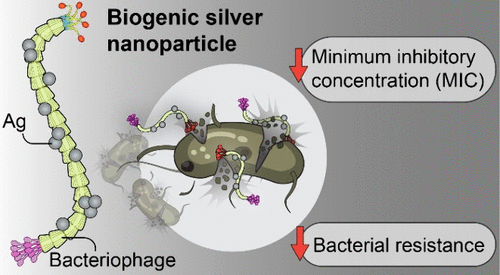
A recent study from the University of California offers an exciting step forward. Researchers developed a new form of silver nanoparticle (AgNP) that is substantially more effective against harmful bacteria and even slows down the rate at which resistance forms. Interestingly, the team used the bacteriophage M13 as the biological template to grow these nanoparticles.
Why Silver Nanoparticles?
For years, silver nanoparticles have been used in medical materials from wound dressings to urinary catheters because silver naturally disrupts bacterial growth. Unlike antibiotics, which often target a single cellular pathway, silver acts through multiple mechanisms:
- It triggers oxidative stress
- It damages proteins
- It can interfere with bacterial DNA
This multi-attack strategy makes silver especially attractive in the AMR era. It is much harder for bacteria to develop resistance when the threat comes from several directions at once.
However, conventional silver nanoparticles still come with limitations: they can be toxic at high concentrations, their potency is not always consistent, and bacteria can still eventually adapt.
Phage-Templated Nanoparticles: A Different Approach
The researchers tackled these limitations through a method called biotemplating. They began with purified M13 bacteriophage long, filamentous virus that infects E. coli, and mixed it with a silver nitrate (AgNO₃) solution.
The phage’s surface carries charged components that naturally act as tiny reducing agents. As the silver ions were reduced, metallic silver began to form directly on the virus, shaping nanoparticles along the phage’s rod-like structure. This process produced particles with a unique and highly reactive surface.
The result was striking:
- Phage-templated AgNPs were over 30 times more potent than standard commercial silver nanoparticles.
- Bacteria developed resistance to these phage-grown particles 10 times more slowly.
- The nanoparticles showed strong activity against several Gram-negative pathogens, including E. coli, Pseudomonas aeruginosa, and Vibrio cholerae.
This improvement is not just incremental—it suggests that using biological templates could fundamentally reshape how we design antimicrobial materials.
What This Means for the Future of AMR
The idea that a virus—one that normally infects bacteria—can help build a better antibacterial material is a perfect reminder of how nature often provides the best tools. By leveraging the structure of M13, the researchers created nanoparticles that are both highly potent and less likely to drive rapid resistance.
While more work is still needed, especially around safety and clinical application, this approach demonstrates real promise. Biotemplating could enable a new generation of antimicrobial materials that are more effective, more stable, and significantly harder for bacteria to evade.
In a world where antibiotic resistance continues to rise, innovations like this provide a much-needed sense of direction—and perhaps, hope.
More information: Bagchi, D., Adhikari, A., McCarthy, K., Kang, D., Chen, Y., & Chen, I. A. (2025). Silver Nanoparticles Templated by the M13 Phage Exhibit High Antibacterial Activity against Gram-Negative Pathogens and a Reduced Rate of Bacterial Resistance In Vitro. https://pubs.acs.org/doi/full/10.1021/acs.langmuir.5c03695. Langmuir.
Cover photo credit Bangchi, et al 2025


Leave a Reply
You must be logged in to post a comment.