Researchers have engineered a non-pathogenic Escherichia coli strain to produce lytic bacteriophages inside the gut, reducing Salmonella Typhimurium colonisation and improving survival in mice.
Delivering phages to bacterial infections is not always straightforward. In the gut, phages can be rapidly cleared, while their target bacteria may reach high concentrations or become difficult for phages to access.
A new study published in Nature Microbiology explores a different approach: instead of administering phages alone, researchers engineered a bacterium that can produce them inside the gut.
Making bacteria produce phages
The team engineered non-pathogenic E. coli to carry a modified P22 prophage. P22 naturally targets Salmonella Typhimurium, but the researchers altered the system so that the phage produced by the engineered bacteria would be obligately lytic.
In other words, the engineered bacteria could maintain the phage genetic material while producing phage particles capable of infecting and killing S. Typhimurium.
The researchers also modified the system to help the phage overcome restriction–modification defences in Salmonella, which can otherwise limit phage infection.
They refer to the resulting engineered bacteria as a “lyto-lysogen”.
A phage factory inside the gut
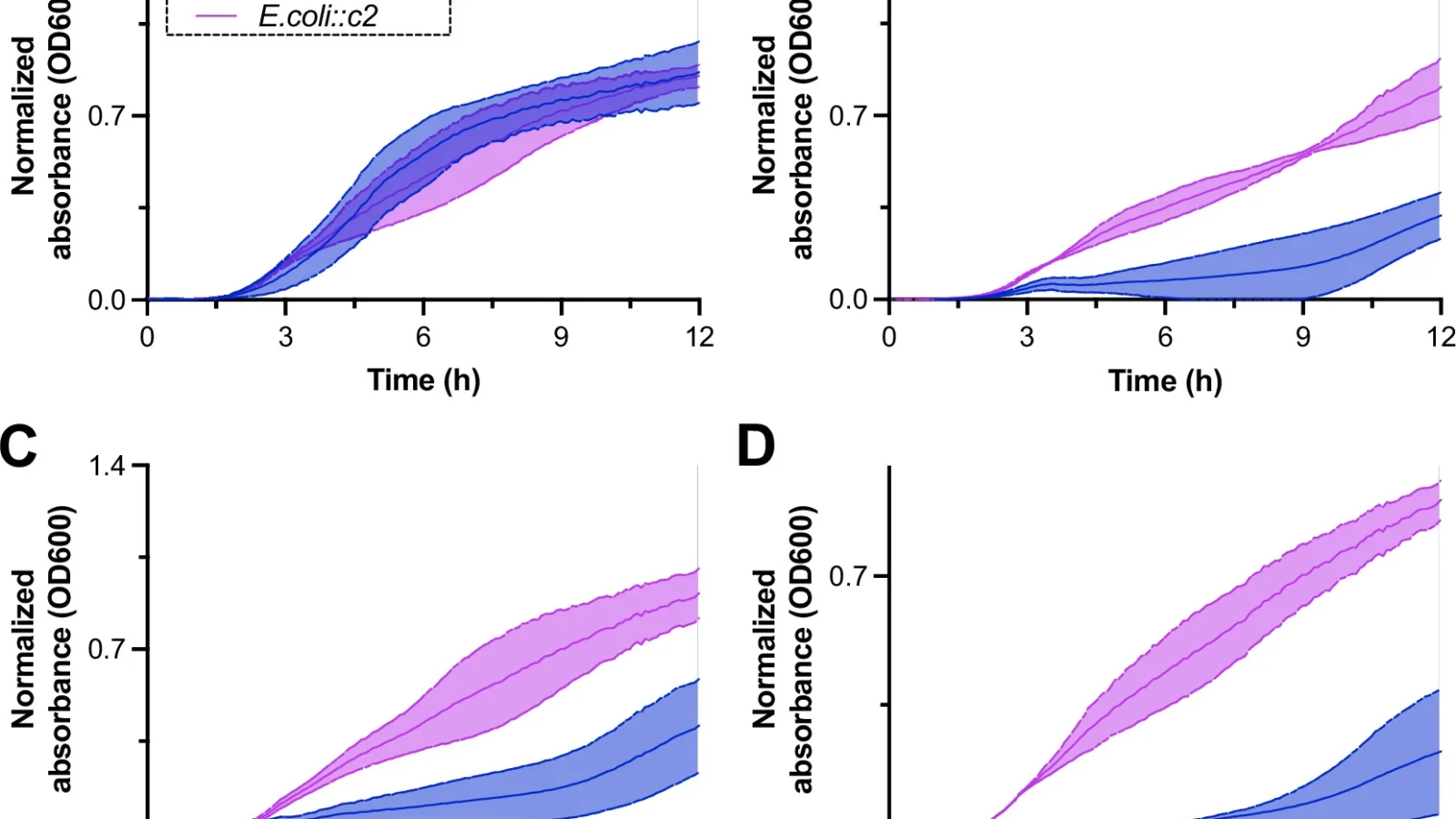
In laboratory experiments, the engineered E. coli almost completely eliminated S. Typhimurium during co-culture. Free phage alone produced a much smaller reduction and did not prevent the bacteria from eventually persisting.
The researchers then moved to mouse models.
Mice were first colonised with the engineered E. coli. Four days later, they were challenged with S. Typhimurium. The engineered bacteria continued producing phage in the gut, resulting in lower levels of Salmonella and improved survival compared with mice given non-engineered E. coli.
The contrast with free phage was particularly interesting. When free P22* phage was administered several days before infection, it was cleared from the gut within a day and did not provide the same protection. The engineered bacteria, by contrast, maintained measurable phage levels in the intestine.
Why the approach is interesting
One of the challenges of phage therapy is getting enough phage to the right place at the right time.
The gut presents a particularly difficult environment. Phages may be lost during passage through the gastrointestinal tract, while pathogens can establish large populations before treatment begins. The authors therefore reasoned that establishing a local source of phage before infection could overcome some of these limitations.
The idea is not simply to give a patient more phage. Instead, the engineered bacterium acts as a local producer, potentially maintaining phage concentrations where the target pathogen is encountered.
This fits into a broader area of phage research in which scientists are exploring ways to improve how phages are delivered, engineered and used against bacterial infections.
For researchers working with phages, some of the underlying laboratory concepts are familiar. The Phage has previously covered methods such as the phage spot lysis test and plaque assay, which are commonly used to assess phage activity and quantify infectious phage particles.
An important limitation: this is still a mouse study
The findings are promising as a proof of concept, but they should not be interpreted as evidence that this is ready for use as a human phage therapy.
The experiments were performed in controlled mouse models. The researchers used streptomycin to help establish the engineered E. coli in the mouse gut and to create a reproducible Salmonella infection model. Without streptomycin, the K-12 E. coli strain did not colonise effectively.
There are also several questions that will need to be addressed before this type of strategy could be considered for human use. These include the behaviour of engineered bacteria in the human microbiome, how long they would persist, control of phage production, potential interactions with resident bacteria, phage resistance and the safety and regulatory requirements associated with administering genetically engineered microorganisms.
The study also found that treatment after Salmonella infection was established was less effective than prophylactic colonisation, highlighting an important distinction between preventing pathogen establishment and treating an established infection.
For now, the work provides a proof of concept for a different way of delivering phage therapy: using an engineered bacterial host to produce therapeutic phages directly at the site where they are needed.
Whether this can eventually be translated beyond controlled animal models remains an open question, but the approach adds another option to the growing toolkit of engineered phage and microbiome technologies.
Reference
Bataglioli, R. A., Baaziz, H., Avalos, H. F. et al. Prophage-encoding engineered bacteria enable prophylactic lytic phage therapy for enteric infection in mice. Nature Microbiology (2026).