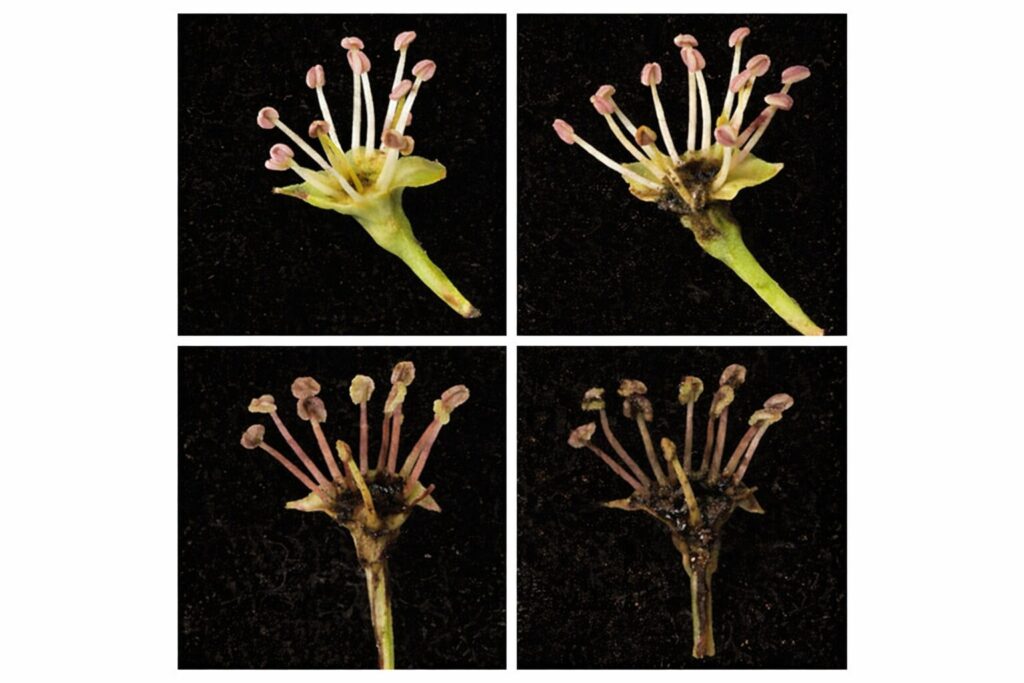
Fire blight, caused by Erwinia amylovora, is one of the most destructive bacterial diseases affecting pear and apple orchards. It spreads rapidly through blossoms, the main entry point for infection, and outbreaks have been increasing in multiple regions, putting pressure on growers to find alternatives to antibiotics and chemical controls.
A new study by researchers from the University of California, Berkeley and the National Institute of Agricultural Sciences, Republic of Korea, tested whether bacteriophages can control fire blight without harming the natural microbial community living on flowers.
Researchers applied a multi-phage “FireFighter” cocktail to Callery pear blossoms and then inoculated them with E. amylovora. In a controlled blossom assay, phage-treated flowers developed far fewer disease symptoms than untreated blossoms, showing a clear reduction in disease severity.
The team then tracked the floral microbiome using 16S rRNA sequencing. As expected, introducing E. amylovora alone pushed the microbiome into dysbiosis, diversity dropped, and the pathogen became dominant. But when blossoms received the phage cocktail before pathogen exposure, microbial diversity and community structure were partially restored, consistent with the idea that removing the dominant pathogen allows the broader community to rebound.
Most importantly for environmental safety, phage application did not significantly alter the natural floral microbiome when applied without the pathogen. Even testing a single phage from the cocktail showed minimal disruption of overall community composition.
Together, the results support a key promise of phage biocontrol: high specificity. In this fire blight system, the phages reduced pathogen burden and symptoms while leaving the resident flower microbiome largely intact, suggesting phage treatments can be both effective and microbiome-friendly in agricultural disease control.
Read: Holtappels, D., Wu, K. U., Koskella, B., & Roh, E. (2025). Impact of phage treatment on fire blight disease outcome and floral microbiome composition. Applied and environmental microbiology, 91(11), e0159825. https://doi.org/10.1128/aem.01598-25 (Cover photo by Holtappels et al (2025))


Leave a Reply
You must be logged in to post a comment.